
Conquest, Conversion, and Complexity: What History Actually Tells Us About Christian and Islamic Empires

Why History Becomes Dangerous When Simplified
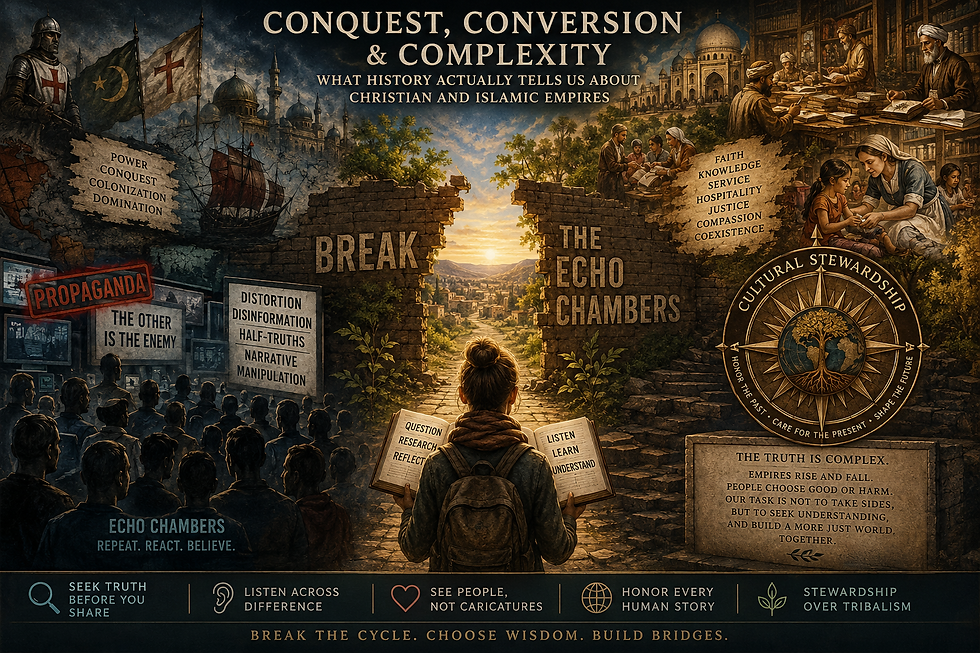
Few topics illustrate this more clearly than the histories of Christian and Islamic empires. In modern public discourse, these histories are frequently weaponized into competing slogans:
“Islam spread by the sword,” “Christianity colonized the world,” “one religion conquered while the other converted peacefully,” or “one civilization was uniquely violent.” Each claim contains enough historical fragments to sound persuasive, but not enough complexity to be truthful.
The historical record is far more layered. Both Christian and Islamic empires expanded through conquest. Both used religion as a source of legitimacy. Both produced systems of rule that could tolerate religious difference in some contexts and suppress it in others. Both were shaped by political ambition, economic interest, military opportunity, theological conviction, and human fear. Neither tradition can be honestly reduced to conquest alone, nor can either be detached from the empires that carried its symbols across continents.
The work of Cultural Stewardship begins here: not with defending a tribe, but with examining the story.
Early Islamic Expansion: Conquest Without Immediate Mass Conversion
The early Islamic conquests began in the seventh century after the death of Muhammad (PBH) in 632 CE. Arab armies moved rapidly out of the Arabian Peninsula into territories controlled by the Byzantine and Sasanian empires. Within decades, Muslim-ruled polities controlled Syria, Egypt, Iraq, Persia, and parts of North Africa. Under the Umayyad Caliphate, expansion continued west into the Iberian Peninsula and east into Central Asia and Sindh.
This expansion was military. It was not merely spiritual persuasion. Armies conquered territory, displaced older imperial structures, and established new political authority. Historians such as Hoyland and Kennedy emphasize the speed and scale of these conquests, while also noting that the early Islamic empire emerged in a world already shaped by exhausted imperial powers, regional rivalries, and complex local responses (Hoyland, 2015; Kennedy, 2007).
However, conquest and conversion were not the same thing.
One of the most misunderstood aspects of early Islamic rule is that conversion to Islam did not usually happen immediately or uniformly. In many conquered regions, Christians, Jews, Zoroastrians, and other religious communities remained demographically significant for centuries. Islamic rule created a new political order, but religious transformation occurred gradually, unevenly, and through multiple pressures and incentives.
Non-Muslim monotheists were often incorporated as dhimmis, protected but subordinate communities. This status allowed them to maintain religious institutions, family law, and communal life, but within an unequal legal order. Dhimmis typically paid the jizya, a poll tax levied on many non-Muslim adult males, and faced various restrictions depending on region, ruler, time period, and legal interpretation.
This system should not be romanticized as modern pluralism. It was not equality. Yet it also should not be flattened into the claim that all conquered peoples were immediately forced to convert at swordpoint. The truth is more complicated: Islamic empires often tolerated religious minorities under structured inequality while simultaneously creating social, legal, and economic incentives that made conversion increasingly attractive over generations.
Conversion could mean relief from jizya, access to elite networks, greater social mobility, and fuller participation in the ruling order. But it could also arise through intermarriage, patronage, urbanization, trade, Sufi networks, local politics, sincere belief, and gradual cultural integration. In other words, Islam spread through conquest, but Islamization was not identical to conquest.
Christian Expansion: From European Conversion to Global Colonialism
Christian history also contains multiple forms of expansion. Christianity began as a minority movement within the Roman Empire, later became imperial religion, and eventually spread across Europe through a combination of preaching, royal conversion, monastic networks, political alliances, coercion, and cultural transformation.
Richard Fletcher’s work on the Christianization of Europe makes clear that conversion was never merely a private theological event. It involved law, literacy, kingship, property, social order, and cultural change (Fletcher, 1999). When rulers converted, populations often followed through a mixture of conviction, pressure, political necessity, and social adaptation. Medieval Christianization, like Islamization, was rarely a single moment. It was a long process.
The global expansion of Christian empires took a different shape after the fifteenth century. Spain, Portugal, Britain, France, the Netherlands, and Russia expanded across oceans and continents. The Age of Exploration fused maritime technology, military power, commercial ambition, dynastic competition, and religious mission.
Spanish and Portuguese imperial expansion was especially explicit in linking conquest and evangelization. The Spanish Crown claimed responsibility for spreading Christianity in the Americas and the Philippines. Missions served multiple functions: religious conversion, political pacification, cultural assimilation, labor organization, and imperial administration.
The National Park Service describes Spanish missions as institutions that sought to convert Indigenous peoples, pacify territories for colonial purposes, and acculturate Native communities into Spanish norms (National Park Service, 2016).
The Requerimiento, issued in 1513, remains one of the starkest examples of theology turned into imperial legal theater. Spanish conquistadors read this document to Indigenous peoples, often in Spanish or Latin, demanding acknowledgment of papal and Spanish authority. Failure to comply could be used to justify war, enslavement, and dispossession. The absurdity was brutal: people were expected to submit to claims they often could not understand, issued by strangers who had arrived armed and already convinced of their right to rule.
Yet here too, history resists simplicity. Christian conversion in colonial contexts was not only coercion. It also involved Indigenous agency, adaptation, resistance, syncretism, and selective participation. Gerbner (2015) argues that historians must treat conversion as a complex process of transformation rather than assuming that non-European converts were either passive victims or purely strategic actors. Some converts embraced Christian rites sincerely. Others blended Christian practices with existing cosmologies. Others resisted, outwardly complied, or transformed Christianity into something local and new.
This does not excuse colonial violence. It simply refuses to erase the agency of the people who lived through it.
The Question of “Who Conquered More”
Comparisons between Christian and Islamic empires are difficult because the categories are uneven. “Christian empires” can refer to Rome, Byzantium, medieval kingdoms, Spanish and Portuguese Catholic empires, Protestant British and Dutch empires, Russian Orthodoxy, or settler colonial states. “Islamic empires” can refer to the Rashidun, Umayyad, Abbasid, Fatimid, Ottoman, Safavid, Mughal, or numerous regional dynasties. Each had distinct political structures, legal systems, and relationships to religion.
If the question is territorial reach across modern nation-states, European Christian empires eventually controlled more global territory, especially after the rise of maritime colonialism. The British Empire alone became the largest empire in history, and Spanish, Portuguese, French, Dutch, and Russian expansion transformed the Americas, Africa, Oceania, and large parts of Asia. J. H. Elliott’s comparative work on Britain and Spain in the Americas emphasizes that these empires built new colonial worlds on the ruins of Indigenous civilizations and reshaped global history in enduring ways (Elliott, 2006).
If the question is speed of early expansion, the early Arab-Islamic conquests were extraordinary. Within roughly a century, Muslim-ruled armies and administrations had transformed the political map from Iberia to Central Asia. The scale was stunning, particularly given the collapse or weakening of older imperial rivals.
But numbers alone can mislead. Counting conquered modern countries imposes present-day borders onto premodern worlds. Empires did not conquer “modern nations” as we understand them. They conquered cities, regions, trade routes, kingdoms, tribal territories, and imperial provinces. A better question is not “which religion conquered more?” but “how did religious identity interact with imperial power in different historical contexts?”
That question produces a more honest answer.
Religion as Justification, Identity, and Administration
Both Christian and Islamic empires used religion to legitimize rule. In Islamic caliphates, the ruler’s authority was tied to the protection and expansion of the Muslim community, though actual governance depended heavily on taxation, military organization, bureaucracy, and local elites. In Christian colonial empires, monarchs and missionaries often framed conquest as a divine mandate to spread the faith, civilize peoples, and reorder the world.
But religion was rarely the only driver.
Empires sought land, labor, tribute, trade routes, military advantage, ports, prestige, and strategic depth. Religion provided moral language, institutional structure, and identity, but it operated alongside economic and political interests. The Spanish did not cross the Atlantic only to save souls. They also sought gold, land, labor, and imperial glory. Early Islamic armies did not expand only from spiritual zeal. They also inherited and redirected older imperial systems, secured revenue, and built political authority.
Reducing empire to religion alone obscures the machinery of power.
At the same time, reducing empire to economics alone ignores how deeply religious conviction shaped historical actors. Many missionaries sincerely believed they were saving souls. Many Muslim rulers sincerely understood their authority through Islamic categories. Many converts, whether to Christianity or Islam, experienced genuine religious transformation.
History becomes distorted when we assume everyone was either cynical or pure.
All were human.
The Danger of Civilizational Caricatures
Modern arguments about Christian and Islamic conquest often tell us more about present anxieties than past realities. Some people invoke Islamic conquest to portray Muslims as inherently violent. Others invoke Christian colonialism to portray Christianity as nothing more than imperial domination. Both approaches flatten human history into propaganda.
Islamic rule included conquest, hierarchy, taxation, legal inequality, intellectual flourishing, plural communities, oppression, tolerance, trade, scholarship, and violence. Christian imperial history included evangelization, coercion, colonial extraction, education, abolitionist movements, cultural destruction, sincere conversion, theological debate, and anti-colonial resistance.
Neither civilization was one thing.
Neither tradition belongs only to its empires.
And no living Muslim, Christian, Jew, atheist, Hindu, Buddhist, Indigenous person, or anyone else should be reduced to the worst actions ever committed under a banner they did not personally carry.
This matters because history shapes how we see our neighbors. When history is taught selectively, fear becomes easy. When history is weaponized, people become categories. When entire communities are defined by conquest, no one is encountered honestly.
Cultural Stewardship asks something better of us.
It asks us to examine before repeating.
To distinguish between conquest and conversion.
To distinguish between empire and ordinary believers.
To distinguish between a government, a theology, a people, and a person.
To ask where our inherited narratives came from and who benefits when we keep repeating them.
What History Actually Teaches
The history of Christian and Islamic empires does not give us a clean scoreboard.
It gives us a warning.
Religious language can inspire compassion, sacrifice, learning, and beauty. It can also be used to justify conquest, hierarchy, exclusion, and violence. Empire has repeatedly wrapped itself in sacred language because sacred language moves people. It gives political ambition the sound of divine purpose.
That is not unique to one religion.
It is a human pattern.
The question for our time is not whether Christians or Muslims have cleaner hands. History will not give either side that comfort. The better question is whether we are willing to tell the truth without turning it into a weapon.
Christian empires conquered.
Islamic empires conquered.
The histories of Christianity and Islam cannot be reduced to either conquest or compassion because both contain examples of each. Millions of ordinary believers throughout history have expressed their faith through service, charity, hospitality, education, and care for their communities. At the same time, political leaders have often invoked religious language to justify conquest, hierarchy, and expansion. Understanding this distinction is essential if we hope to avoid confusing empires with the people who lived under them.
Indigenous peoples, Jews, Christians, Muslims, Africans, Asians, and countless local communities navigated these systems with agency, suffering, adaptation, resistance, and creativity.
That is the truth history gives us.
Not simplicity.
Responsibility.
Conclusion: Beyond the Scoreboard
If we approach history only to prove our tribe innocent and someone else’s guilty, we have already failed the lesson.
The point is not to decide which civilization was worse. The point is to understand how power works when it borrows the language of God, civilization, destiny, or truth.
The task before us is not historical amnesia. It is historical maturity.
We can acknowledge Islamic conquest without reducing Muslims to conquerors.
We can acknowledge Christian colonialism without reducing Christians to colonizers.
We can acknowledge religious violence without denying religious beauty.
We can acknowledge sincere faith without ignoring what empires did in its name.
That is the discipline of Cultural Stewardship.
It does not ask us to sanitize history.
It asks us to stop using history as a blunt instrument.
Because the world does not need more people armed with half-truths.
It needs people willing to sit with complexity long enough for wisdom to arrive.
References
Elliott, J. H. (2006). Empires of the Atlantic world: Britain and Spain in America, 1492–1830. Yale University Press.
Fletcher, R. A. (1999). The barbarian conversion: From paganism to Christianity. University of California Press.
Gerbner, K. (2015). Theorizing conversion: Christianity, colonization, and consciousness in the early modern Atlantic world. History Compass, 13(3), 134–147. https://doi.org/10.1111/hic3.12227
Hoyland, R. G. (2015). In God’s path: The Arab conquests and the creation of an Islamic empire. Oxford University Press.
Kennedy, H. (2007). The great Arab conquests: How the spread of Islam changed the world we live in. Da Capo Press.
National Park Service. (2016). The significance of Spanish colonial missions in our national story and our common heritage with Spain, Mexico and Latin America. U.S. Department of the Interior.
Selhausen, F. M. zu. (2019). Missions, education and conversion in colonial Africa. African Economic History Network Working Paper Series, No. 48.


I just finished reading your article Conquest, Conversion & Complexity, and I wanted to thank you for writing it. I appreciated that you avoided simplistic narratives and instead presented the historical complexity behind the expansion of both Christian and Islamic empires. The distinction you made between military conquest and religious conversion was especially valuable, as those concepts are often conflated in public discussions.
I’m interested in comparative history and how political, social, and religious forces interact over long periods of time, so your article gave me a balanced perspective to think about. Thank you for contributing to a more nuanced discussion of such a sensitive topic.