
Cultural Dilution: The Search for Belonging in an Age of Fragmentation

Over the last several years, I have become increasingly interested in a phenomenon I call Cultural Dilution. By this, I do not mean the natural exchange of cultures that occurs through migration, travel, friendship, trade, or globalization. Human beings have always borrowed from one another, learned from one another, and been shaped by one another.
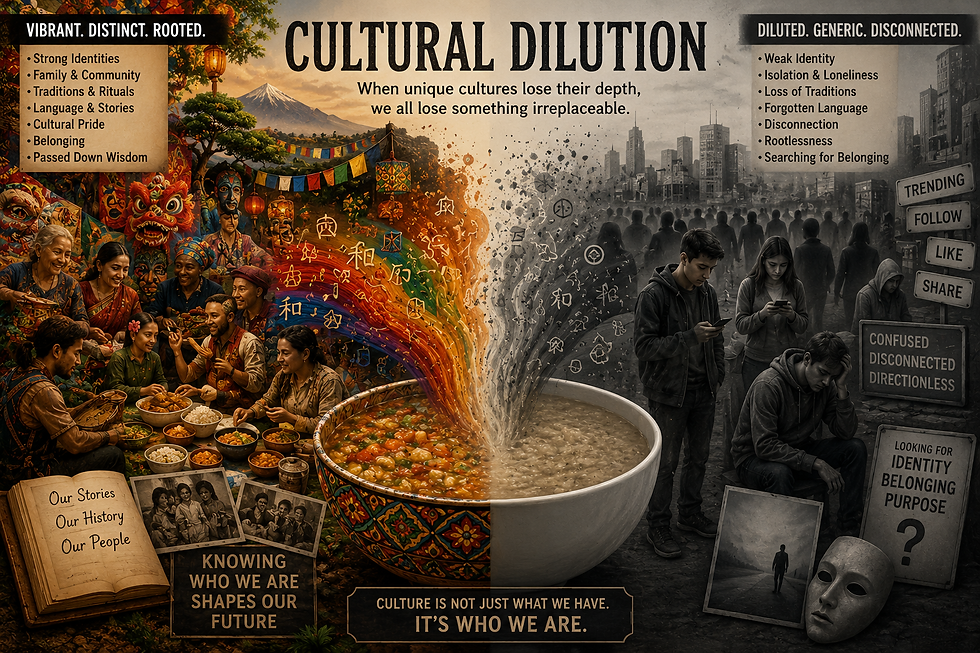
Cultural Dilution refers instead to the gradual weakening of meaningful cultural inheritance: family traditions, ancestral stories, ethnic identity, language, faith practices, local community bonds, shared rituals, and collective memory. It is not the blending of cultures that concerns me. It is the flattening of them.
Culture provides more than recipes, holidays, music, or clothing. It gives people a map. It tells them where they come from, who they belong to, what values shaped them, and what larger story they are part of. Healthy cultural identity often functions as a social safety net. It connects individuals to elders, family stories, community expectations, shared responsibility, and inherited wisdom.
When those connections weaken, people do not stop needing belonging. They simply begin searching for it elsewhere.
That search is now visible on a massive scale. In 2023, the U.S. Surgeon General reported that approximately one in two American adults had experienced loneliness in recent years, with some of the highest rates among young adults (U.S. Department of Health and Human Services, 2023). The World Health Organization has also identified loneliness and social isolation as global concerns, estimating that roughly one in six people worldwide experience loneliness (World Health Organization, 2023). These numbers matter because they suggest that millions of people are not merely bored, moody, or temporarily disconnected. They are living with weakened social bonds and unmet belonging needs.
This is where Cultural Dilution becomes more than nostalgia. It becomes a public concern.
Psychologists Roy Baumeister and Mark Leary argued that the need to belong is a fundamental human motivation. Human beings require frequent, meaningful, and stable relational bonds, and the absence of those bonds is associated with significant emotional and psychological harm (Baumeister & Leary, 1995). In other words, belonging is not sentimental frosting on the cake of human life. It is part of the cake. Remove it, and the whole thing collapses into isolated crumbs.
Robert Putnam’s work on social capital adds another layer. In Bowling Alone, Putnam documented the decline of civic participation and social connectedness in the United States, arguing that traditional forms of community life had significantly weakened over time (Putnam, 2000). Social capital includes the networks, norms, and trust that allow people to work together and feel connected to a shared community. When those networks deteriorate, individuals become more isolated, communities become less resilient, and society becomes more vulnerable to fragmentation.
This fragmentation can create openings for unhealthy substitute identities.
Research on extremism and radicalization repeatedly points to the role of loneliness, isolation, identity uncertainty, and unmet needs for significance and belonging. RAND’s work on violent extremism in America found that former extremists and their families often described social isolation, loneliness, trauma, and instability as part of the pathway into extremist spaces. The same research also found that relationships, diverse exposure, emotional support, and stable community ties often helped people exit extremist movements (RAND Corporation, 2021).
Michael Hogg’s Uncertainty-Identity Theory provides a useful explanation for why this happens. Hogg argues that when individuals feel uncertain about who they are, where they belong, or what their lives mean, they may become attracted to groups that provide clear identity, strong norms, certainty, and firm boundaries (Hogg, 2014). These groups can be healthy, but they can also become rigid ideological silos, extremist movements, conspiracy communities, or high-control groups. Certainty can be comforting. It can also become a cage with matching T-shirts.
Arie Kruglanski’s work on the “quest for significance” further supports this pattern. His research suggests that people are often drawn toward extreme ideologies when they experience a loss of meaning, dignity, recognition, or personal importance. Extremist movements can exploit that wound by offering a sense of heroic purpose, belonging, and moral clarity (Kruglanski et al., 2022). The ideology may be the visible doorway, but the deeper hunger is often significance.
Research on cults and high-control groups reflects similar dynamics. People experiencing major life transitions, isolation, weak social support, grief, identity disruption, or a longing for belonging may be more vulnerable to groups that offer intense community, certainty, structure, and purpose. The first attraction is often not doctrine. It is relationship. People are not always recruited through belief first. Often, they are recruited through belonging.
This does not mean that cultural loss directly causes radicalization, cult involvement, or ideological extremism. That would be too simplistic. People are complex, and so are their pathways into unhealthy groups. But the research does suggest a strong relationship between weakened belonging, identity uncertainty, social disconnection, and vulnerability to substitute communities that offer identity, purpose, and certainty.
That is the heart of Cultural Dilution Theory.
When meaningful cultural inheritance weakens, people may lose access to some of the healthiest forms of identity formation: family history, tradition, intergenerational wisdom, religious or spiritual grounding, ethnic memory, local community, and embodied practices of belonging. If nothing healthy replaces those structures, a vacuum forms.
Nature dislikes a vacuum. Human beings do too.
In America, this vacuum is often filled by consumer identity, political tribalism, algorithmic communities, online outrage, conspiracy movements, or ideological sorting. People who no longer know their great-grandparents’ stories may know every slogan of their chosen political tribe. People who no longer gather around family tables may gather in comment sections. People who have lost inherited rituals may find new rituals in outrage cycles, livestreams, hashtags, and digital mobs.
This is not community. It is belonging’s counterfeit cousin.
The antidote is not cultural purity, exclusion, or retreat from diversity. In fact, fear-based cultural preservation becomes its own sickness. The antidote is Cultural Stewardship.
Cultural Stewardship invites people to recover their own stories while honoring the stories of others. It asks individuals to learn their family histories, preserve meaningful traditions, reconnect with elders, understand the faith and values that shaped their people, and participate in local communities. At the same time, it encourages humility, curiosity, and respectful exchange across cultures.

This is where Jon Jaxson’s phrase, “Respect the Flavors,” becomes so important. In one of our conversations, he used flavors as a way to describe what happens when culture is flattened. A rich soup, gumbo, or stew does not become stronger because every ingredient tastes the same. It becomes powerful because each flavor remains distinct while contributing to something larger. The same is true of culture.
America does not need every culture boiled down into beige broth.
It needs people who know who they are deeply enough to meet others without fear. It needs communities where difference is not erased, exploited, or performed, but honored. It needs kitchen tables, elders, stories, languages, rituals, music, mourning practices, foodways (Culinary Traditions), and real human conversation. It needs people rooted enough to be generous.
Perhaps one reason so many people are searching for identity today is not because they have too much culture, but because they have too little connection to it. The challenge before us is not to retreat from the world. It is to rebuild belonging within it.
If loneliness, polarization, cult-like thinking, and radicalization are symptoms of fragmentation, then meaningful cultural connection may be part of the cure. Cultural Dilution names the problem. Cultural Stewardship points toward the repair. Sacred Earth Journey Round Table

Cultural Dilution, Belonging, and the Search for Home: Community Round Table Questions
When you hear the word "home," what comes to mind first? A place, a people, a culture, a memory, or something else?
Personal Reflection
What traditions from your family or culture have had the greatest impact on who you are today?
Are there traditions, stories, or cultural practices that have been lost in your family over time?
Do you feel connected to your cultural heritage? Why or why not?
What cultural values or traditions do you hope future generations will preserve?
Have you ever experienced a longing to learn more about your ancestry, heritage, or family history?
Belonging and Identity
Where do you experience your strongest sense of belonging?
Do you think modern society provides enough opportunities for genuine community and connection?
Why do you think loneliness has become such a significant issue despite our unprecedented levels of digital connectivity?
What role does cultural identity play in helping people develop confidence and resilience?
Is it possible to be deeply rooted in your own culture while remaining open to others? What does that look like?
Cultural Dilution
Have we lost something valuable as cultures become increasingly homogenized and commercialized?
What does "Respect the Flavors" mean to you?
What happens when people lose connection to family stories, traditions, and community?
Do you believe cultural identity provides a form of social support or safety net?
Is there a difference between cultural exchange and cultural dilution? If so, how would you describe it?
Echo Chambers and Polarization
Why do you think so many people are drawn to ideological tribes, online communities, or highly polarized groups?
What healthy forms of belonging can help prevent people from falling into unhealthy silos or extremist communities?
How can communities create spaces where people feel seen, heard, and valued?
What role do curiosity and hospitality play in reducing polarization?
What is one thing we can do to rebuild trust and belonging in our communities?
What is one tradition, practice, or conversation you would like to bring back into your family or community? Reflect on Your Own Story
If culture provides a map, how well do you know your own?
Many people can name their favorite influencer, political figure, or celebrity, but struggle to tell the stories of their grandparents, family traditions, cultural roots, or the experiences that shaped their identity.
The Sacred Space Journal was created to help individuals slow down, reflect, and reconnect with the stories that matter.

Inside, you'll find guided prompts exploring:
Identity
Heritage
Belonging
Faith
Family
Curiosity
Community
Personal growth
Because before we can steward other cultures responsibly, we must first understand our own.
The journey inward is often the first step toward understanding the world around us.
References
Baumeister, R. F., & Leary, M. R. (1995). The need to belong: Desire for interpersonal attachments as a fundamental human motivation. Psychological Bulletin, 117(3), 497-529.
Hogg, M. A. (2014). From uncertainty to extremism: Social categorization and identity processes. Current Directions in Psychological Science, 23(5), 338-342.
Kruglanski, A. W., Molinario, E., Webber, D., & Di Cicco, G. (2022). Significance-quest theory. Perspectives on Psychological Science, 17(4), 1050-1071.
Putnam, R. D. (2000). Bowling alone: The collapse and revival of American community. Simon & Schuster.
RAND Corporation. (2021). Violent extremism in America: Interviews with former extremists and their families. RAND Corporation.
U.S. Department of Health and Human Services. (2023). Our epidemic of loneliness and isolation: The U.S. Surgeon General’s advisory on the healing effects of social connection and community.
World Health Organization. (2023). Social isolation and loneliness. World Health Organization.


Comments