
What the Data Actually Shows About Terrorism, Religion, and Reality

A conversation worth having… and getting right

The story we are told about terrorism is simple.The data is not.What happens when we look closer?
This article examines global terrorism statistics to better understand how violence is distributed across regions and ideologies.
When comparing terrorism and religion, the data reveals a far more complex relationship than commonly assumed.
Understanding who the victims of terrorism are is critical to challenging widely held misconceptions.
There’s a certain kind of graphic that circulates every few months. Clean numbers. Bold claims. One religion. One conclusion.
It feels convincing.
Until you actually look at the data.
This article does not aim to defend narratives, but to test them against credible datasets and ask a more grounded question:
What does terrorism actually look like when we stop simplifying it?
The First Problem: The Data Doesn’t Work That Way
There is no global dataset that cleanly categorizes terrorism by religion alone.
The Global Terrorism Database defines terrorism as violence carried out to achieve political, economic, religious, or social goals. That means motivations are often overlapping rather than singular (RECONNECT 2021, 6–7).
Europol similarly notes that categories such as “jihadist,” “right-wing,” or “left-wing” are analytical tools, not rigid or purely theological classifications (Europol 2025, 6–7).
Any claim that assigns global violence to one religion with precision is already oversimplifying the data.
Where Terrorism Actually Happens
Terrorism is not evenly distributed globally. It clusters in regions experiencing instability.
In 2025:
Deaths declined from 7,714 to 5,582
Attacks decreased from 3,492 to 2,944
Over half of all terrorism-related deaths occurred in the Sahel (Institute for Economics & Peace 2026, 2–4, 32–38)
This pattern reflects conflict environments, not religious calendars.

Figure 1. Global terrorism deaths and attacks, 2024–2025.
Source: Institute for Economics & Peace, Global Terrorism Index 2026.
Europe: What the Data Actually Shows
European Union data provides a clear example of ideological diversity in terrorism.

Figure 2. EU terrorist attacks by ideology, 2024.
Source: Europol, EU Terrorism Situation and Trend Report (TE-SAT) 2025.
In 2024:
24 jihadist attacks
21 left-wing/anarchist
4 separatist
1 right-wing
8 other (Europol 2025, 7, 13–14)
At first glance, jihadist attacks appear dominant. But when all other categories are combined, they exceed jihadist incidents.
This distinction matters.
Jihadist violence is a significant component of the threat landscape, but it does not represent the whole. When viewed collectively, other ideological forms of terrorism account for a larger share.

Figure 3. EU terrorist attacks: jihadist vs other combined, 2024.
Source: Europol, EU Terrorism Situation and Trend Report (TE-SAT) 2025.
This reinforces a key point:
Terrorism is multi-ideological, not monopolized by any single belief system.
Inside “Jihadist” Violence
Even within what is labeled “jihadist,” there is no single unified structure.
Major datasets do not classify attacks by Islamic sect. However, examining known organizations reveals clustering around a small number of groups:
ISIS and affiliates
Al-Qaeda networks
Boko Haram / ISWAP
Al-Shabaab
These groups are often associated with Sunni extremist interpretations, but their operations are also shaped by political objectives, territorial control, and local conflict dynamics.

Figure 4. Organizational distribution within jihadist attacks (global approximation).
Source: Derived from patterns identified in Global Terrorism Database (GTD), ACLED, and Institute for Economics & Peace reporting.).
This further underscores that “jihadist” is not a purely religious category, but a hybrid of ideological, political, and strategic factors.
The United States: A Different Pattern
Patterns shift across regions.
In the United States, right-wing extremism accounts for the majority of terrorist incidents over time. It represented approximately two-thirds of attacks and plots in 2019 and early 2020. Religious extremism accounts for higher cumulative fatalities due to events such as 9/11 (Jones et al. 2020, 1–3).
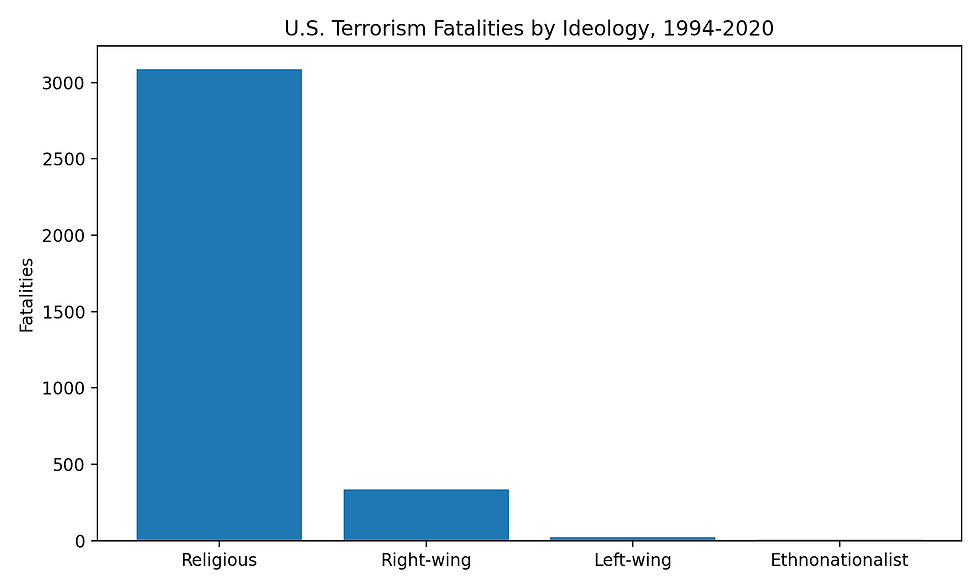
Figure 5. U.S. terrorism fatalities by ideology, 1994–2020.
Source: Jones et al., Center for Strategic and International Studies (CSIS).
Again, the conclusion holds:
No single ideology dominates across all contexts.
Who Pays the Price
This is often the most overlooked dimension.
Most victims of terrorism are:
Civilians
Local populations
Individuals living within conflict zones

Figure 6. Victims of terrorism by category (global trend approximation)
As illustrated in Figure 6, civilians represent the overwhelming majority of victims in global terrorism patterns, with violence disproportionately affecting populations within conflict-affected regions.
In the case of Islamist extremist violence, many of those victims are themselves Muslim. The Global Extremism Monitor found that the majority of victims are civilians in Muslim-majority countries (Munasinghe et al. 2020, 32, 75).

Figure 7. Distribution of terrorism victims by region (Muslim-majority vs non-Muslim-majority regions).
This reinforces a critical point:
The populations most commonly associated with these attacks are often those most affected by them.
What Muslims Actually Think
Public opinion data provides important context.
Pew Research found that majorities in many Muslim-majority countries reject violence against civilians:
Pakistan: 89%
Indonesia: 81%
Nigeria: 78%
Tunisia: 77%
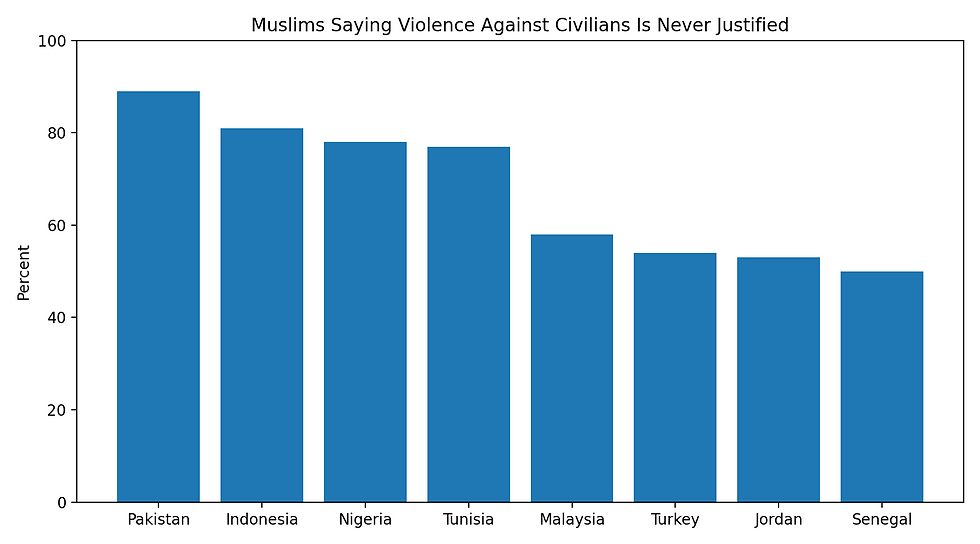
Figure 7. Muslim rejection of violence against civilians (selected countries).
In addition, no extremist organization surveyed received majority support among Muslim populations, and favorable views of ISIS remained below 15% globally (Pew Research Center 2013; Poushter 2015).
So What’s the Truth?
Not the loudest version. Not the simplest one.
The real pattern looks like this:
Terrorism is concentrated in conflict zones
It emerges from multiple ideologies
Motivations are layered, not singular
And the people most affected are often the ones least represented in the narrative
Final Thought
The strongest available evidence does not support simplified narratives about terrorism.
Instead, it shows:
Terrorism is concentrated in conflict zones
It is driven by multiple ideologies
Motivations are layered, not singular
Victims are often those closest to the conflict
And Muslim populations are frequently both targets and opponents of extremist violence
If a graphic can explain global violence in one sentence, it is likely not explaining it.
If the data teaches us anything, it is that terrorism cannot be understood through shortcuts or collective blame. It demands nuance, context, and the discipline to separate individuals from the actions of extremist groups. This is where the conversation must continue, not as debate, but as reflection. At Sacred Earth Journey, we believe these questions are not abstract; they are deeply human. They shape how we see one another, how we respond to fear, and whether we choose division or understanding. The Round Table exists to hold that space, where assumptions are challenged, complexity is welcomed, and where, ultimately, Global Peace Begins at Kitchen Tables. We invite you to take these questions beyond the page and into conversation. Share them with your family, your friends, your community. Sit down at a table, physical or virtual, and engage with them honestly. Listen as much as you speak. Challenge assumptions, including your own. If you feel called, join us at the Sacred Earth Journey Round Table, where these conversations continue across perspectives, cultures, and lived experiences. This is not about having the right answers. It is about creating space for better questions, deeper understanding, and the kind of dialogue that reminds us we are more connected than divided.
Round Table Community Questions
How do simplified narratives about terrorism shape public perception and policy?
What responsibility do media and individuals have in verifying data before sharing it?
How can we better distinguish between religious identity and political violence?
What role does geography play in shaping patterns of extremism?
How can communities build resilience against propaganda and misinformation?
What does responsible, informed dialogue about global conflict actually look like?
To what extent should individuals be held accountable for the actions of groups they share an identity with, whether religious, national, or cultural?
What are the social and psychological impacts of being collectively associated with acts of violence one does not support or condone?
How can societies distinguish between individual identity and extremist ideology without reinforcing bias or stigma?
References
Europol. 2025. EU Terrorism Situation and Trend Report (TE-SAT) 2025. The Hague: Europol.
Herre, Bastian, Veronika Samborska, Hannah Ritchie, and Max Roser. 2023. “Terrorism.” Our World in Data.
Institute for Economics & Peace. 2026. Global Terrorism Index 2026. Sydney: Institute for Economics & Peace.
Jones, Seth G., Catrina Doxsee, Nicholas Harrington, Grace Hwang, and James Suber.
2020. The Escalating Terrorism Problem in the United States. Washington, DC: Center for Strategic and International Studies.
Munasinghe, Serena, et al. 2020. Global Extremism Monitor: Islamist Violence after ISIS. London: Institute for Global Change.
Pew Research Center. 2013. Muslim Publics Share Concerns about Extremist Groups. Washington, DC: Pew Research Center.
Pew Research Center. 2013. The World’s Muslims: Religion, Politics and Society. Washington, DC: Pew Research Center.
Poushter, Jacob. 2015. In Nations with Significant Muslim Populations, Much Disdain for ISIS. Washington, DC: Pew Research Center.
RECONNECT Consortium. 2021. The Relationship Between Terrorist Threats and Democratic Political Regimes. Deliverable 11.3.
Roche, MaryClare, and Michael Robbins. 2023. “What Palestinians Really Think of Hamas.” Arab Barometer / Foreign Affairs.


Comments