
Missile Strike on Minab Girls’ School: Legal Analysis Under International Humanitarian Law

Abstract
On 28 February 2026, international media reported that a missile strike destroyed the Shajareh-Tayyebeh girls’ elementary school in Minab, Iran, resulting in significant civilian casualties. Competing official narratives emerged regarding responsibility for the strike. This article first summarizes verified reporting from reputable international news organizations and official statements. It then analyzes the incident under international humanitarian law (IHL), focusing on distinction, proportionality, precautions in attack, dual-use doctrine, attribution standards, and state versus individual responsibility. The article emphasizes evidentiary thresholds required for legal determination and distinguishes political accusation from legal proof.

I. Reported Incident and Competing Attribution Claims
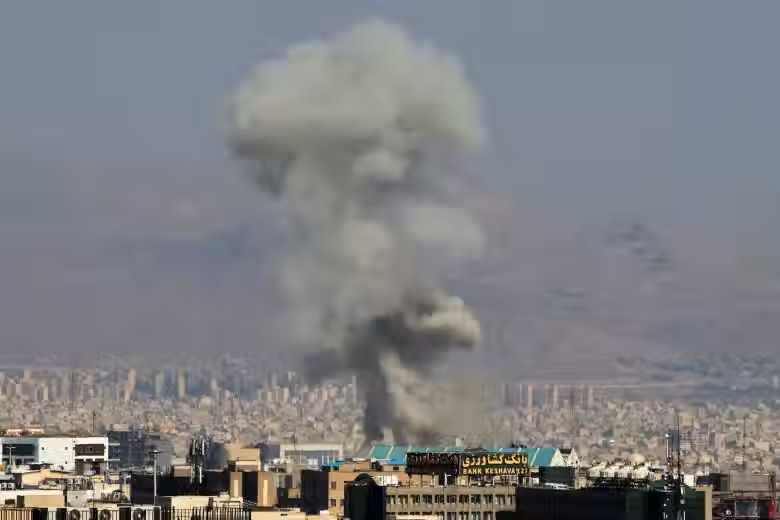
On 28 February 2026, during the opening phase of coordinated military operations conducted by the United States and Israel against targets inside Iran, a missile struck the Shajareh-Tayyebeh girls’ elementary school in Minab, located in Iran’s Hormozgan Province. International outlets including Time, The Guardian, Financial Times, and Le Monde reported that the strike occurred during school hours and resulted in dozens to over one hundred fatalities, many of them schoolchildren (Time 2026; The Guardian 2026; Financial Times 2026; Le Monde 2026).
Iranian state officials publicly attributed the strike to the joint U.S.–Israeli military operation that began that same day. Iranian media further reported that the school was located near a facility associated with the Islamic Revolutionary Guard Corps (IRGC), suggesting that nearby military targets were engaged in the broader campaign (Le Monde 2026).
The United States and Israel denied intentionally targeting the school. U.S. Central Command acknowledged awareness of civilian casualty reports and stated that it does not target civilians and would review the allegations. Israeli defense authorities stated that they were not aware of conducting an operation at that specific location (Time 2026).
At the time of reporting, no independently published forensic analysis had conclusively identified the origin of the missile. International reporting consistently noted that media access within Iran was restricted and that casualty figures and attribution claims relied substantially on official Iranian sources (The Guardian 2026; Financial Times 2026).
Accordingly, as of the latest credible reporting, attribution remains contested and not independently verified.
II. Governing Legal Framework
International humanitarian law governs conduct in armed conflict. The foundational rules derive from the 1949 Geneva Conventions and the 1977 Additional Protocol I.
Distinction
Article 48 of Additional Protocol I codifies the principle of distinction, requiring parties to distinguish between civilians and combatants and between civilian objects and military objectives (ICRC 1987, 599–600).
Article 52(1) establishes that civilian objects shall not be the object of attack (ICRC 1987, 633).
Schools are presumptively civilian objects.
III. Military Objectives and Dual-Use Doctrine
Under Article 52(2), an object becomes a lawful military objective only if, by its nature, location, purpose, or use, it makes an effective contribution to military action and its destruction offers a definite military advantage (ICRC 1987, 635–636).
The International Committee of the Red Cross emphasizes that this definition must be interpreted narrowly to preserve civilian protection (ICRC 1987, 636).
Proximity to a military installation does not itself convert a civilian object into a lawful target (Dinstein 2016, 124–126). For a school to lose protection, evidence must demonstrate actual military use.

IV. Proportionality and Precautions in Attack
Article 51(5)(b) prohibits attacks expected to cause incidental civilian harm that would be excessive in relation to the concrete and direct military advantage anticipated (ICRC 1987, 684–685).
Article 57 further requires feasible precautions in attack, including target verification and the choice of means and methods to minimize civilian harm (ICRC 1987, 680–683).
The U.S. Department of Defense Law of War Manual reiterates these obligations, requiring target validation, collateral damage estimation, and reassessment when new information emerges (DoD 2023, §§5.6, 7.15).
If a military target near the school was lawfully engaged, proportionality analysis would require assessment of:
• Civilian presence
• Time of day
• Blast radius
• Weapon selection
• Intelligence quality
Failure to conduct adequate precautionary review may constitute a violation even absent intent to target civilians.
V. War Crime Thresholds
Under Article 8(2)(b)(ii) and (iv) of the Rome Statute of the International Criminal Court, the following constitute war crimes:
• Intentionally directing attacks against civilian objects
• Launching disproportionate attacks
The ICC Elements of Crimes require proof that the perpetrator knew the object was civilian or that civilian harm would be clearly excessive (ICC 2011, 15–16).
International Criminal Tribunal for the former Yugoslavia jurisprudence affirms that deliberate or indiscriminate attacks on civilian structures violate customary international law (ICTY 2003, paras. 57–59).
Intent, knowledge, and foreseeability are central elements.
VI. Attribution and Evidentiary Standards
Legal responsibility requires reliable attribution. Determining the origin of a missile typically involves:
• Fragment analysis
• Guidance system identification
• Radar tracking data
• Satellite launch detection
• Command and control documentation
Absent independent forensic findings, definitive legal conclusions regarding responsibility remain premature.
International law distinguishes between political accusation and evidentiary proof. Public statements by states do not alone establish legal attribution.
VII. State Responsibility Versus Individual Criminal Liability
Even if individual criminal intent cannot be proven, a state may incur responsibility for an internationally wrongful act under customary international law principles reflected in the Articles on State Responsibility.
Individual criminal responsibility requires proof beyond reasonable doubt of intent or knowledge under international criminal law standards. State responsibility requires proof of attribution to state organs and breach of an international obligation.
These are analytically distinct frameworks.
Conclusion
International humanitarian law provides a structured framework for evaluating attacks on educational institutions during armed conflict. Schools are protected civilian objects unless and for such time as they are used for military purposes. Even when military objectives are present nearby, proportionality and precautionary obligations remain binding.
As of the latest credible reporting, responsibility for the Minab school strike remains contested and not independently verified. Legal characterization of the event depends on reliable forensic attribution and detailed examination of targeting decisions, proportionality assessments, and precautionary measures taken.
Until such evidence is available, definitive legal conclusions remain provisional.
References
Dinstein, Yoram. 2016. The Conduct of Hostilities under the Law of International Armed Conflict. 3rd ed. Cambridge: Cambridge University Press.
Financial Times. 2026. “Strike on Iranian Primary School Kills Dozens, Authorities Say.” March 1, 2026.
International Committee of the Red Cross (ICRC). 1987. Commentary on the Additional Protocols of 8 June 1977. Geneva: ICRC.
International Criminal Court (ICC). 2011. Elements of Crimes. The Hague: ICC.
International Criminal Tribunal for the former Yugoslavia (ICTY). 2003. Prosecutor v. Galić, Case No. IT-98-29-T.
Le Monde. 2026. “Iran’s State Media Say 100 Killed in Strike on Girls’ School.” March 1, 2026.
The Guardian. 2026. “Death Toll from School Bombing in Southern Iran Reportedly Rises.” March 1, 2026.
Time. 2026. “More Than 100 Reported Killed in Strike on Girls’ Elementary School in Iran.” March 1, 2026.
U.S. Department of Defense (DoD). 2023. Law of War Manual. Washington, DC: Department of Defense.
United Nations. 2001. Draft Articles on Responsibility of States for Internationally Wrongful Acts. New York: United Nations.


Comments